25 April 2012

Byblos and Beyond

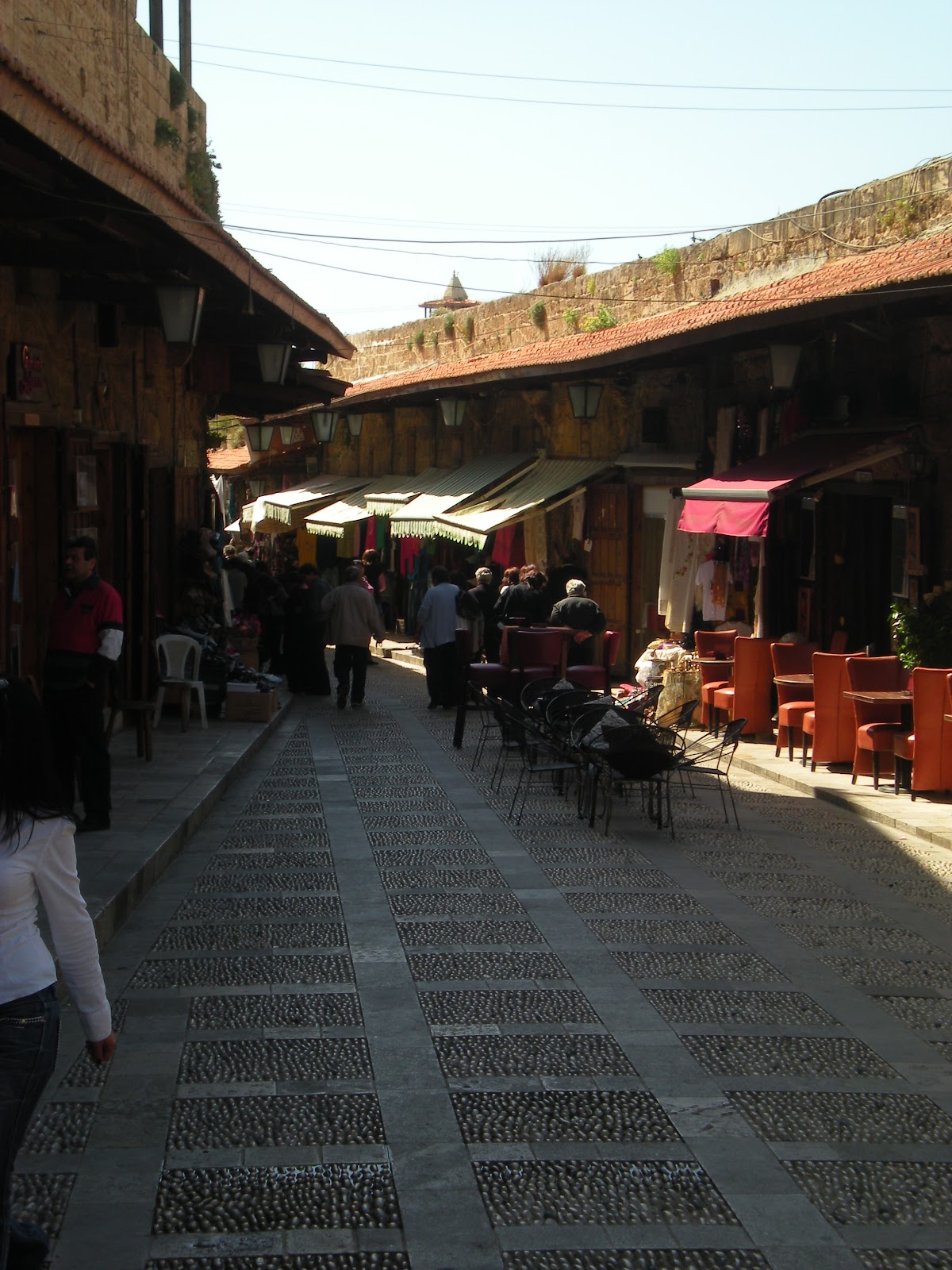
My first day in my Beirut office was Orthodox Easter Monday so at about mid day the people I was there to work with declared it a holiday and took me sight seeing! Our first stop was Byblos which is a charming (if touristy) port town on the Mediterranean.


 Hurrah for shopping!


 Old Marionite church


 Lovely old Lebanese style buildings


The port is also really charming. It used to be a pretty active fishing village but the Mediterranean is rather fished out these days. A lot of the boats now take on passengers for tours and such. There is a nearby beach and a resort as well for sun bathing and swimming. I had a great time wandering around with my colleagues; and have to admit that I fell into the tourist trap myself! I bought a fantastic turquoise caftan embroidered with gold thread and beads. I will wear it around the house every day now.

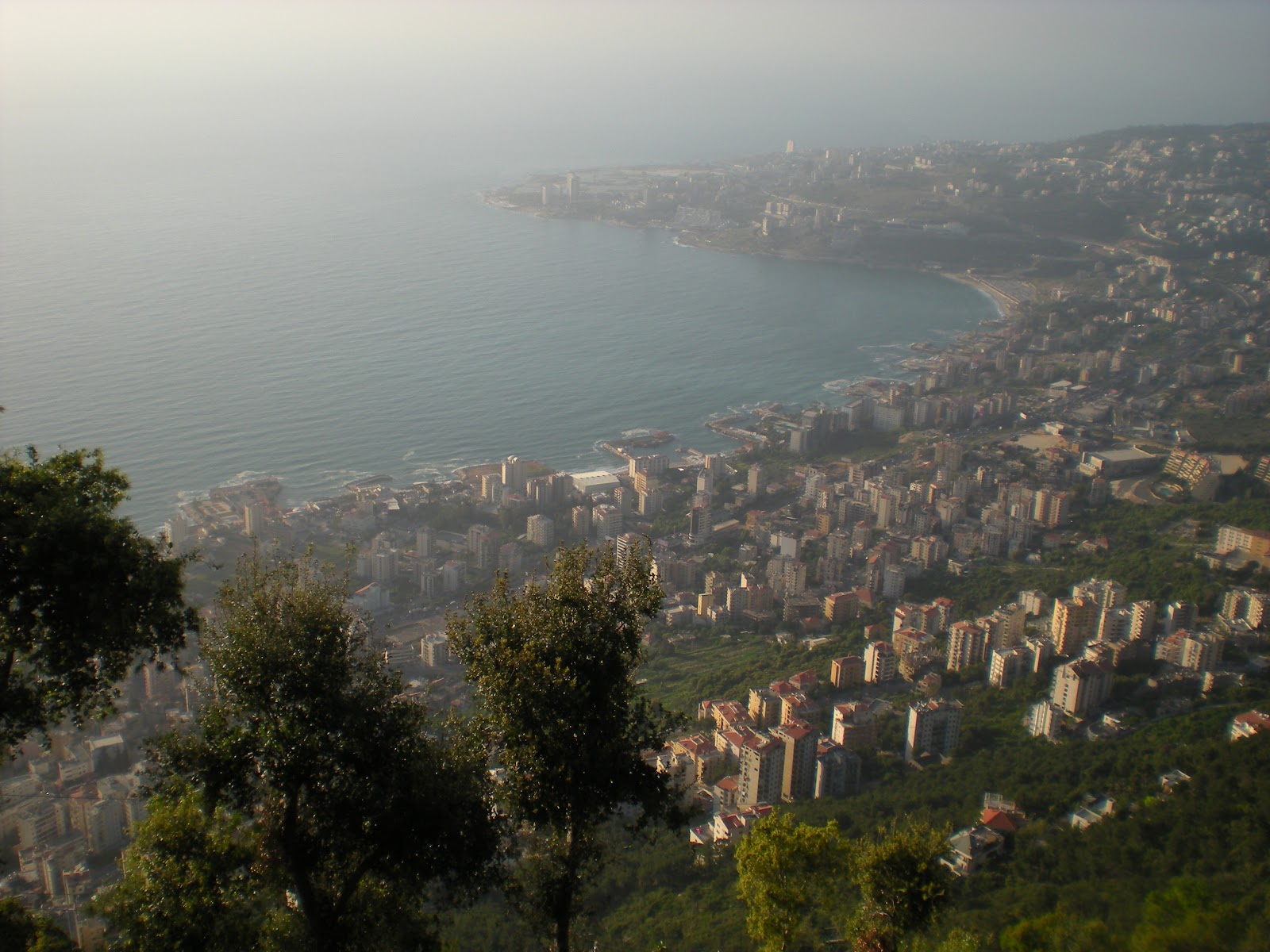
After we left Byblos they drove me up the mountain to Harissa which is a pilgrimage sight for Maronites. Unfortunately it was under reconstruction so I couldn't take any pictures of the actual church, but I did get a shot of the view from above and a picture of Our Lady.


After Our Lady of Lebanon we went to another, nearby church, St. Paul's Melkite Greek Catholic church. Melkite Greek Catholics?! I am a cradle Catholic and I think Lebanon has more Catholic sects (all in harmony with Rome, thank you) than I've ever heard of. In any case, St. Paul's was gorgeous-I just wish my pictures had turned out a little better.


 His Holiness, Pope John Paul II visited Beirut and St. Paul's in 1997. It was the first visit by a Roman pontiff to a Middle Eastern church since 1964. In honor of that visit, the artists of St. Paul included a portrait of His Holiness in the church.


I also got a chance one evening to visit 'downtown' Beirut.


I think one of the most amazing things to me about Lebanon was that the city does not have the infrastructure to manage 24/7 electricity (in the center of Beirut it goes out on average 3 hours a day-elsewhere it's worse) but despite that in the souks downtown in Beirut you can find every designer shop you can think of...and some you've never even heard of.

My brief taste of Lebanon was more than enough to entice me back. I had a fantastic time and would love to see more of this beautiful little country. And maybe eat some more really awesome food along the way!

22 April 2012

Behind the T-walls: Swords of Qādisiyyah

Today, after nearly 8 months here, I finally got the chance to visit this famous landmark in Iraq --  

This monument seems to have many names: The Victory Arch, Swords of Qādisīyah, The Hands of Victory, but around here, it's most commonly known as The Crossed Swords. After my meeting in the IZ ended today a little earlier than expected, we finally got a chance to go down the road so that I could get a view of these myself, and cross another item off the list of things to see in Baghdad.


Commissioned in 1986, these arches were to commemorate Iraq's victory in the Iran-Iraq war. The war didn't end, however, for two more years. There are two sets of crossed swords, each pair located at either end of a parade ground near where the Museum of Gifts to the President once stood, near the Presidential Complex, along with the reviewing stand where Saddam would view the Republican Guard; where he was seen in those infamous images firing a rifle into the air. As we drove back, I also noticed that we passed the Tomb of the Unknown Soldier, which, if I were allowed to see it at night, sounds like it looks pretty cool.

According to Wikipedia, the blades are made of stainless steel and weigh 24 tons each. Our security team told me today that they were made from the guns and tanks of the dead from the war.


An interesting fact is that all of the hands are right hands. The sculptor took impressions of Saddam's right hand and forearm, and cast them in bronze to use as the basis of the monument. When the original sculptor died, I read that his replacement also added an impression of Saddam's thumbprint onto the casts. 


One thing that you can't see is just underneath the swords: there are a bunch of military helmets (now painted yellow) that are supposedly those of Iranian soldiers. Though this monument is just one of many representing the grotesque narcissism of Saddam Hussein, it's still a testament to Iraq's history - both of the Iran- Iraq war, and to the time of Saddam. The historian in me is glad that the 2007 efforts to dismantle the monument were unsuccessful, and that the swords remain a place that you can visit (sort of).


19 April 2012

Behind the T-walls: DUST!


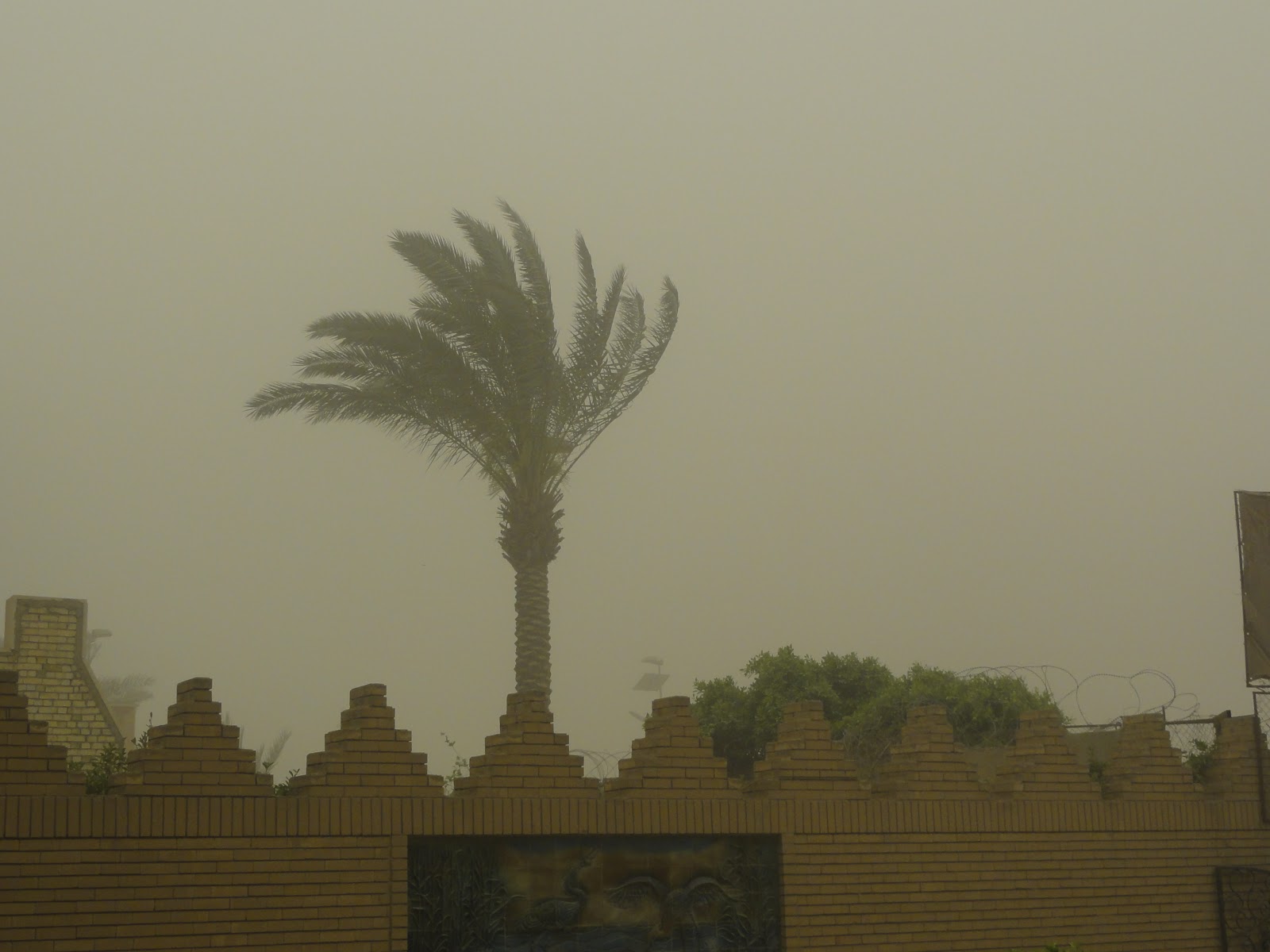
I am writing to you from the middle of a dust storm...yes. Right now a dust storm. There are times when I am reminded that in spite of working in a semi-normal office, and wearing working clothes, and doing working work, I am actually in Iraq. The biggest reminders for me are not usually the blasts (though we hear those sometimes), but the fact that everything, and I mean EVERYTHING is covered in dust. Usually it's just a fine layer of dust, but especially after a storm like this one, it's pretty much caked every where.  Not to mention, if you can see it in the air, it's also in your eyes, in your mouth, and in your food.

I was sitting in my office, and the color of the room changed suddenly. At first I thought that it was because the blinds were blocking out the sun, but no. I looked out the window, and the whole sky was orange, and visibility was pretty much zero. I couldn't see anything. Then I realized, I could also smell the dust in the air. Windows closed, and yes, you can actually smell the dust.


Me against the dust
Then, I thought crap...my dust mask is at home...a lot of good it's doing me there! I ran to get it, braving the dust-laden air, and hoping, no, praying I didn't have an asthma attack on the way. You see, I'm allergic to dust, and I won't be able to get a new inhaler until I go on leave next week! Yes, I know there's dust in Iraq. oops.
Dust-covered flowers

close up of dusty leaves. This is after only 1 hour


Walking back to the office, this is what it looked like.

And then I got back to work and walked to our backyard. I can barely make out the sun (in the top 1/3 of the picture). But then I see that there's something missing. A BIG something. Do you know what it is?


Here, look a little bit closer:

  Still don't know?


This is the same.exact.view on a normal day:
 Yes, it's a HUGE mosque on the other side of the street that missing. 
I was telling someone here to beware the dust, and they reply to me, "We're in Iraq. There's dust here. You didn't know?" Ha. ha. ha.

Ancient City of the Sun

The second stop on our tour was at Baalbeck, also known as Heliopolis. To quite Wikipedia: It is Lebanon's greatest Roman treasure, and it can be counted among the wonders of the ancient world (woot that's two for me now!), containing some of the largest and best preserved Roman ruins.

This is what the city would have looked like.

Here is what remains of the Temple of what was originally thought to be Venus. My tour guide said they now believe it was actually for a goddess of fertility (I forget the name she gave though-she moved us through very quickly).

 Entrance to the city. No idea about the film crew there.


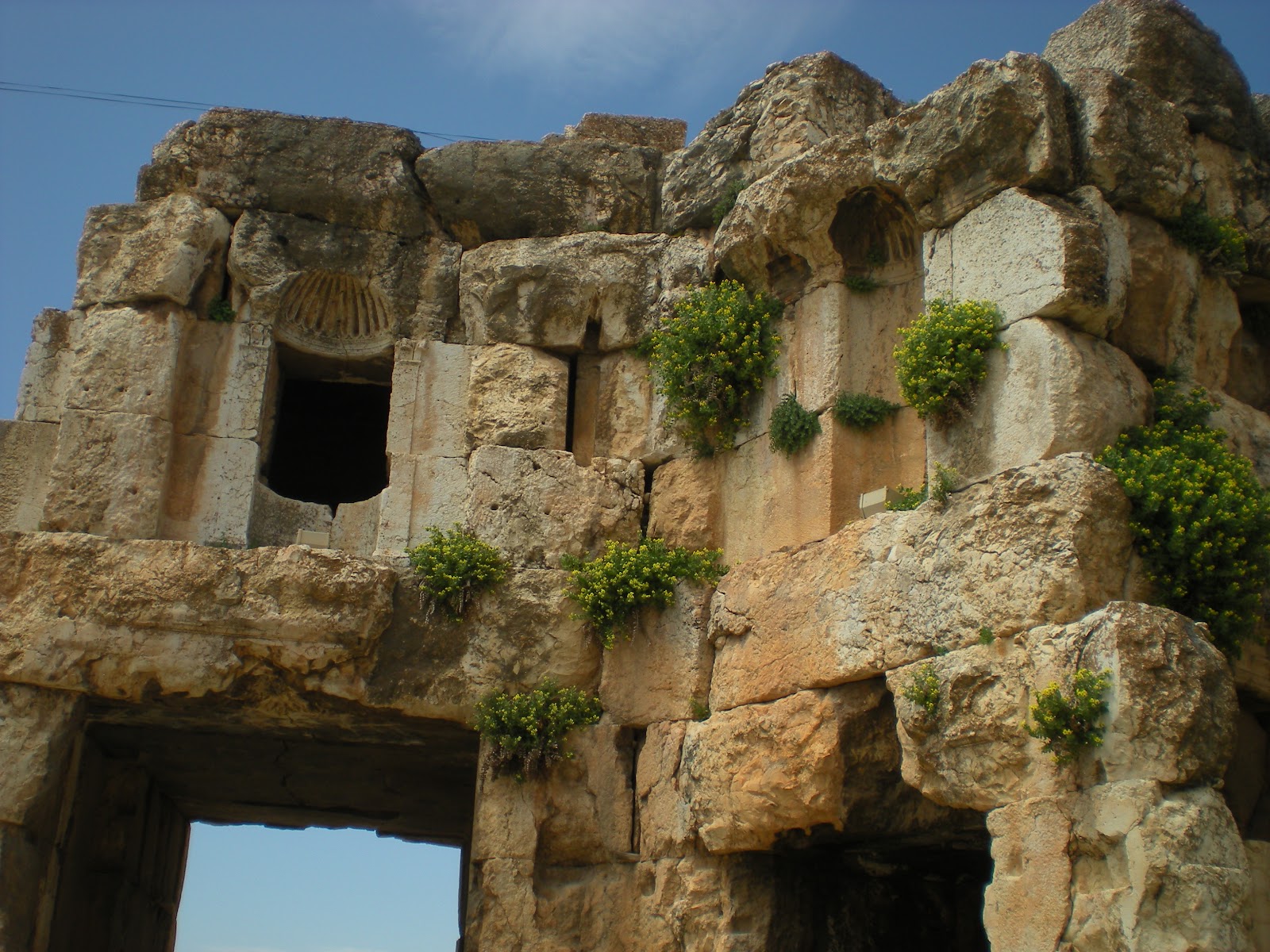
 These niches were believed to hold statues of Greek gods or muses.


After the death of Alexander the Great Heliopolis, or City of the Sun, changed hands a great deal. At one time the main courtyard was covered with a wooden roof and these chambers were added when it served as a Christian church. There was also a mosque built in the city during another period.

 All the remains of the Temple of Jupiter, which was the largest of the city's temples, are these six pillars.

 Of which I took many pictures.

From many angles.

What is most intact is the Temple of Bacchus. While it looked pretty darn large to me, it was a lesser temple in the city in it's day.

 As viewed from the Temple of Jupiter.

 Entrance

 Once again I *heart* Photoshop effects.


 I'm not sure exactly where this fit but I believe it was once part of the outer wall.

 The carving on some of the fallen stones is still very clear and must have been amazing in it's glory.


Baalbeck is not very far from Beirut. I'm very glad some friends suggested I go see this as I would have been very sad to have missed it. If you're ever in Lebanon definitely make room for a visit here in your schedule!

18 April 2012

The City of Anjar

I was really lucky to have a free day when I got to Beirut before I had to start working. So on Sunday I skipped Mass (and felt really guilty because the Catholic Archdiocese church is right next to my hotel) to take a tour. Through a friend's recommendation I went through Nakhal Tours which ended up being a really good deal. For $80 I got picked up and dropped back off at my hotel, had an English speaking tour guide, a nice air conditioned bus, and the tour took us to Anjar, Baalbeck, and Ksara with a stop in the afternoon for a very excellent lunch of Lebanese mezze.

Our first stop was in Anjar, which is heavily Armenian rather than Lebanese, to visit the ruins of the Umayyad city-another World Heritage Site checked off my imaginary list.

 Entry to Umayyad. The main street here once housed shops which lined both sides.

 Remaining colonnades along the main thoroughfare.

 Palace


 I spent a long time photographing the remains of these pillars.

 I love Photoshop.


 Snow capped mountains in the background! It was kind of wild to see those while standing next to a palm tree.

 Lebanon got it's name from an old Semitic word 'leban' meaning white. People called this the white country because of the snowy mountains. You can ski and go to the beach in the same day.


Next up on the tour-Baalbeck! Which is like Anjar but times about 12. But that's for next time.