I might need two posts for this. We were only at the David Sheldrick Wildlife Trust for an hour, which is all the time it's open each day, and I took over 500 pictures. Not hard to do because the center's youngest rescue, Mbegu, is the cutest thing.
I could have watched her try to crawl out of the mud pit forever.


She face planted a lot. This little girl is totally my spirit animal. I like to think that I'm one of the big cats, especially since I'm a Leo and all...but Mbegu and I share the inability to stay on our own two (or four in her case) feet.


Then just as she managed to get out...she turned around and splashed right back in!

The David Sheldrick center functions as an orphanage for elephants cross Kenya. After they're rescued they live at the orphanage until they're about five years old and then are released, usually in Tsavo, where they find and attach themselves to a herd as an adopted family. All the elephants received bottled formula hourly but babies get fed whenever the heck they want. As such, the guys who work with them live on site, many of them sleep in the stalls with the elephants. However no one person works continuously with one elephant so the animals don't get attached and/or too accustomed to people. It's for that same reason that the center is open for only one hour a day.
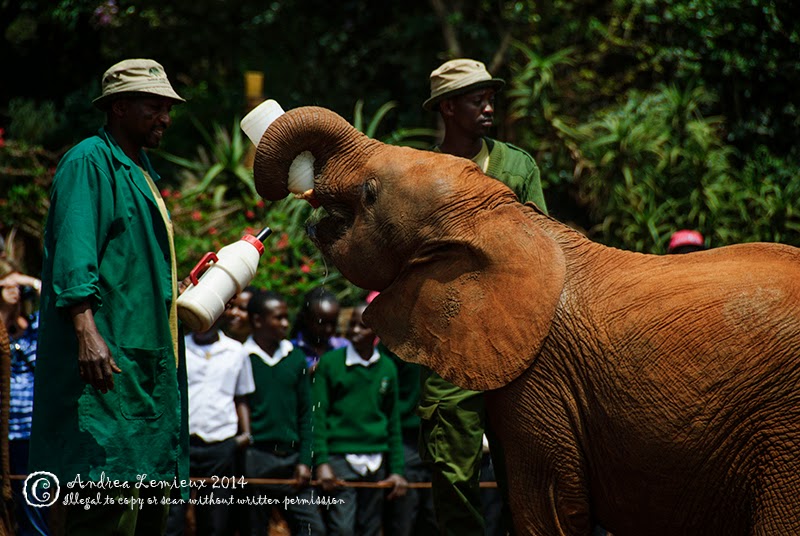


It costs about $900 per day per elephant to take care of them and the orphanage does not limit how many they take in. At the time of my visit I believe there were 26. To offset the cost there is of course an entrance fee, which is surprisingly minimal (1000 Kenyan Schillings ($10) I think it was) but the main sources of funding come from donations and adoptions. You can adopt any one of the elephants and check up on its progress on the center's website. I of course adopted Mbegu :)


The day we visited there were also several schools making a visit. My friends and I marveled at the students as much as we did the elephants. The center's rules are pretty simple: no cell phone use, only touch the elephants if they come near the rope, and do not talk or make noise. No American five year old that I have ever been around, let alone 50-60 of them could keep quiet for 10 minutes but these little kids were quiet and still for a full hour. They were better behaved than a lot of the visiting adults. It was kind of amazing.


Check out all the pictures of Mbegu and the other orphaned elephants on our Google+ and Facebook pages!
I could have watched her try to crawl out of the mud pit forever.
She face planted a lot. This little girl is totally my spirit animal. I like to think that I'm one of the big cats, especially since I'm a Leo and all...but Mbegu and I share the inability to stay on our own two (or four in her case) feet.
Then just as she managed to get out...she turned around and splashed right back in!
The David Sheldrick center functions as an orphanage for elephants cross Kenya. After they're rescued they live at the orphanage until they're about five years old and then are released, usually in Tsavo, where they find and attach themselves to a herd as an adopted family. All the elephants received bottled formula hourly but babies get fed whenever the heck they want. As such, the guys who work with them live on site, many of them sleep in the stalls with the elephants. However no one person works continuously with one elephant so the animals don't get attached and/or too accustomed to people. It's for that same reason that the center is open for only one hour a day.
 |
| Mbegu again-seriously the rest may as well not have been there |
It costs about $900 per day per elephant to take care of them and the orphanage does not limit how many they take in. At the time of my visit I believe there were 26. To offset the cost there is of course an entrance fee, which is surprisingly minimal (1000 Kenyan Schillings ($10) I think it was) but the main sources of funding come from donations and adoptions. You can adopt any one of the elephants and check up on its progress on the center's website. I of course adopted Mbegu :)
 |
| Love how they use their knees |
 |
| Face plant again |
The day we visited there were also several schools making a visit. My friends and I marveled at the students as much as we did the elephants. The center's rules are pretty simple: no cell phone use, only touch the elephants if they come near the rope, and do not talk or make noise. No American five year old that I have ever been around, let alone 50-60 of them could keep quiet for 10 minutes but these little kids were quiet and still for a full hour. They were better behaved than a lot of the visiting adults. It was kind of amazing.
Check out all the pictures of Mbegu and the other orphaned elephants on our Google+ and Facebook pages!


