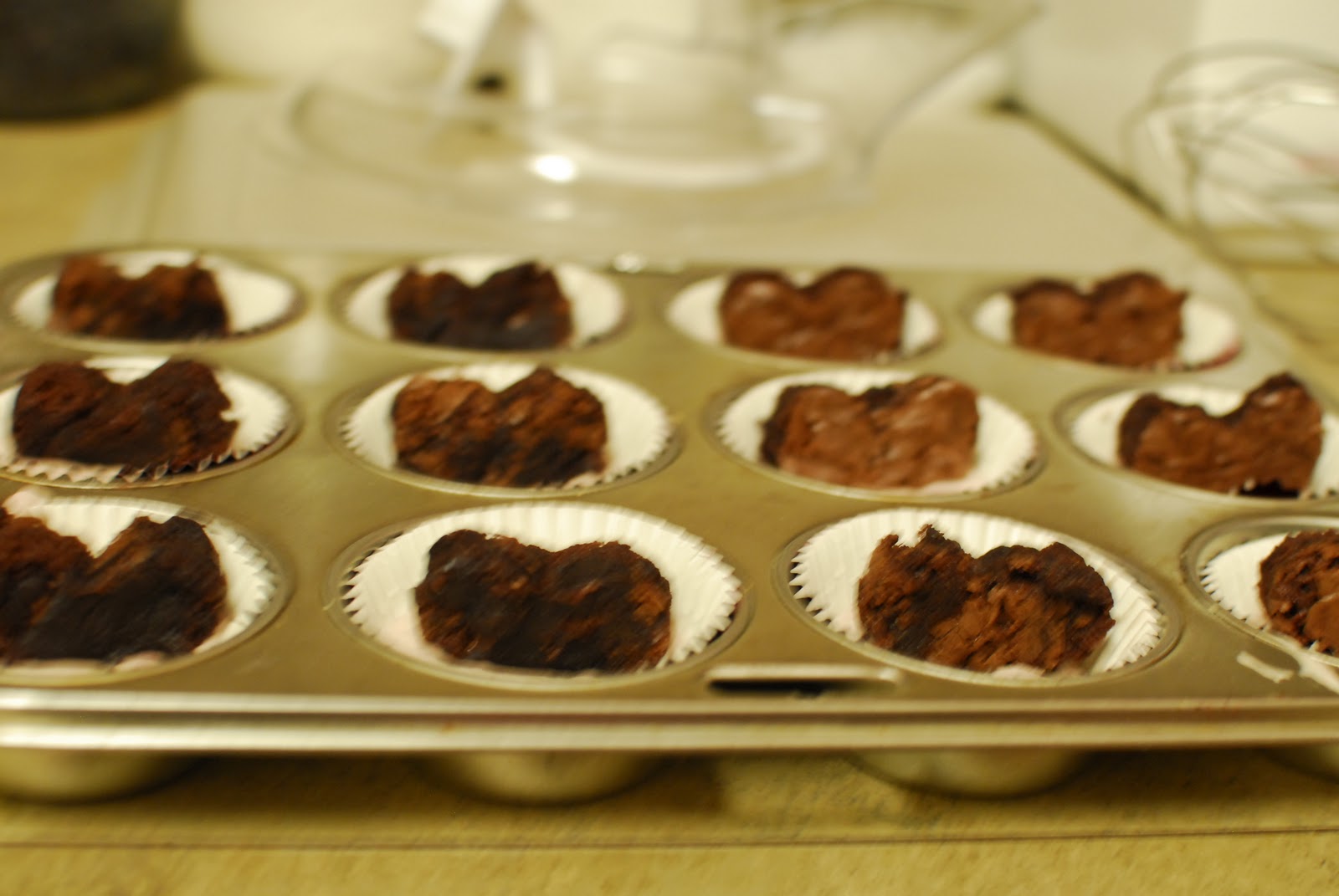
Lauren and I gave the apartment a really deep clean yesterday so I decided that I should mess it up with some baking. No really I've been planning these cupcakes for a while now; the messing up the sparklingly clean kitchen was just a coincidence. You all know that I'm not a fan of the cupcake but over Christmas my mom directed me to this great blog: Bake It In A Cake; creative cupcakes I can totally get behind.
Since it's Valentine's Day, a day that as a chronically single person I pretty much desipse, and I have a lull before the spring and summer birthdays kick into gear, I decided to make cupcakes for work. Using one of my most popular cakes, the strawberry ganache with white chocolate mousse as inspiration, the cupcakes I made were strawberry with a heart-shaped brownie baked inside. I started with the brownies and cheated a little bit in the baking as I do with both brownies and this recipe; I used box mixes. I know, gasp.
The brownies were actually a little tricky. Knowing they would be baked twice I wanted to make sure that they were a little under-baked; but they couldn't be too underbaked or I'd never get them to cooperate and be heart-shaped. I also discovered that under-done brownies are not only yummy to eat, they're also fantastically pliable. Using a small heart-shaped cookie cutter, I cut the brownies until only the extra bits were left in the pan. Not wanting to waste anything, I smooshed up the extra bits and smashed them into the cookie cutter. Viola! Heart-shaped brownies.
To fill the cupcakes, I spooned a small amount of cake batter into the papers then put in the brownies, and covered them carefully with additional cake batter. My first batch I used too much cake so they overflowed a little. And then the next batch didn't quite cover the brownies.
For decoration I bought some "red" candy melts (which were more of a salmon when melted) and made candy hearts. I think they turned out pretty cute myself. So I took a lot of pictures.
And then there was nothing left to do but frost the cupcakes with the white chocolate mousse, add a candy heart, and enjoy!
Two travel writers telling tales of food, life, and adventure on the road of life, and around the world.
14 February 2011
04 February 2011
Doors
Like I mentioned a while back in this post, I really enjoyed the different kinds of doors that everyone had in and around Cambs. Obviously, we have doors here too, but they don't seem to be nearly as interesting, whimsical, colorful, or, well...Bri'ish. I'd like to give a big thank you to K for indulging me in my endeavors to photograph every neat door that I saw, even to the point of whipping the car around so that I could run out and take a few snaps. Thanks again K!
I don't have a lot to say about the doors that I fotoed, but I'm going to share the pictures with you just the same. Maybe someday, I'll frame a bunch of them together and actually put them up on my wall as 'art.'

Backside of the Iron Garden Gate, Anglesey Abbey, Cambridgeshire

...and the Front

Hope Cottage, St Albans

Green Door, St Albans

#27 Door Knocker

St Albans Cathedral

Old Door, Cambridge

Twin Red doors, Cambridge

Red Door with Bike, Cambridge

Old Church Door. St Botolph's, Cambridge

Catholic Rectory Door, Cambridge

Garden Houses, with Blue Doors, St Albans

Small Door, St Albans

Iron Door, Anglesey Abbey

Inside Anglesey Abbey, Cambridgeshire

ME! Outside the Anglesey Abbey Staff entrance
I don't have a lot to say about the doors that I fotoed, but I'm going to share the pictures with you just the same. Maybe someday, I'll frame a bunch of them together and actually put them up on my wall as 'art.'
Backside of the Iron Garden Gate, Anglesey Abbey, Cambridgeshire
...and the Front
Hope Cottage, St Albans
Green Door, St Albans
#27 Door Knocker
St Albans Cathedral
Old Door, Cambridge
Twin Red doors, Cambridge
Red Door with Bike, Cambridge
Old Church Door. St Botolph's, Cambridge
Catholic Rectory Door, Cambridge
Garden Houses, with Blue Doors, St Albans
Small Door, St Albans
Iron Door, Anglesey Abbey
Inside Anglesey Abbey, Cambridgeshire
ME! Outside the Anglesey Abbey Staff entrance
28 January 2011
Cambridge in Black & White
What do you know, I've now blogged four times in the last week, and that is as many times as I blogged for all of 2010. I remember this semi-addicting blogging feeling, and I will continue to try to blog more...as I fodder about which to blog, of course. ;)
My time in Cambridge was pretty brief, but I truly fell in love with the place while I was there. When I pulled into town on the National Express bus the sunny spring morning of my flight from Zambia, I was amazed at how much I felt at home immediately. It's no wonder, really, since it is an "ancient" college town (at least by American standards). Since it was established in 1209, it is more than 600 years older than U of M. We just don't have insitutions in the US that are that old. To quote Eddie Izzard: "I grew up in Europe, where the history comes from. Oh, yeah. You tear your history down, man! “30 years old, let's smash it to the floor and put a car park here!" I have seen it in stories. I saw something in a program on something in Miami, and they were saying, "We've redecorated this building to how it looked over 50 years ago!" And people were going, "No, surely not, no. No one was alive then!". Surely not...and they were definitely not housing insitutions of scientific thought, and certanly not 900 years ago, either.
The city stole my heart immediately. I took a lot of pictures, and I think that buildings like these are really best represented in black and white.


As a college town, with lots of students without cars, and many narrow streets, alleys, and pedestrian pathways where cars aren't allowed, or just won't fit, many people rely on bikes to get around. In fact, Cambs is pretty much known for its bikes:


The towers of the Great St. Mary's (GSM) Church. Staff must live within 20 miles from the Church, and undergraduates must live within 3 miles. It is home to the Cambridge University Organ, and the University Clock (pictured below).


The Cambridge University Clock (on GSM). The Bell tower pictured above houses the bells for this clock.

Though the University itself was founded in 1209, it is comprised of several colleges (I think we would call them schools) with different founders, and varying specialities. Keng Henry VI founded The King's College in 1441. It was intended to be a college for the boys of Eton College (remember the Eton Mess from my last post?). It wasn't until 1865, that the first non-Etonian student began his studies at KC.


I thought the Buildings were really beautiful, and enjoyed an entire afternoon, milling about, and looking at the buildings while savored a lovely afternoon tea complete with scones, clotted cream, and proper lemon curd.

...and also now some other buildings:

St. Botolph's church:


Many of the schools have gates with keepers (dressed in robes like in Harry Potter), and I wasn't allowed inside the grounds of the individual colleges. But I enjoyed glimpsing them, and trying to peek inside where I could:
St. John's College Church

And finally, a place that cemented in my mind that we really don't know anything about good candy in the US:

I LOVED this place. Mr Simms Olde Sweet Shoppe had so many tasty candies, licorice, bonbons, gum balls, gummy candies (my favorite!), boiled candies, and jars of wonderfulness I couldn't believe my eyes.

I think I spent 2 hours in there reveling in multiple levels of floor-to-ceiling sweets. I ultimately came away with about 8GBP of candy that only took me about 15 minutes to eat. I tried to savor it, but I just couldn't. I <3 candy. :)
My time in Cambridge was pretty brief, but I truly fell in love with the place while I was there. When I pulled into town on the National Express bus the sunny spring morning of my flight from Zambia, I was amazed at how much I felt at home immediately. It's no wonder, really, since it is an "ancient" college town (at least by American standards). Since it was established in 1209, it is more than 600 years older than U of M. We just don't have insitutions in the US that are that old. To quote Eddie Izzard: "I grew up in Europe, where the history comes from. Oh, yeah. You tear your history down, man! “30 years old, let's smash it to the floor and put a car park here!" I have seen it in stories. I saw something in a program on something in Miami, and they were saying, "We've redecorated this building to how it looked over 50 years ago!" And people were going, "No, surely not, no. No one was alive then!". Surely not...and they were definitely not housing insitutions of scientific thought, and certanly not 900 years ago, either.
The city stole my heart immediately. I took a lot of pictures, and I think that buildings like these are really best represented in black and white.
As a college town, with lots of students without cars, and many narrow streets, alleys, and pedestrian pathways where cars aren't allowed, or just won't fit, many people rely on bikes to get around. In fact, Cambs is pretty much known for its bikes:
The towers of the Great St. Mary's (GSM) Church. Staff must live within 20 miles from the Church, and undergraduates must live within 3 miles. It is home to the Cambridge University Organ, and the University Clock (pictured below).
The Cambridge University Clock (on GSM). The Bell tower pictured above houses the bells for this clock.
Though the University itself was founded in 1209, it is comprised of several colleges (I think we would call them schools) with different founders, and varying specialities. Keng Henry VI founded The King's College in 1441. It was intended to be a college for the boys of Eton College (remember the Eton Mess from my last post?). It wasn't until 1865, that the first non-Etonian student began his studies at KC.
I thought the Buildings were really beautiful, and enjoyed an entire afternoon, milling about, and looking at the buildings while savored a lovely afternoon tea complete with scones, clotted cream, and proper lemon curd.
...and also now some other buildings:
St. Botolph's church:
Many of the schools have gates with keepers (dressed in robes like in Harry Potter), and I wasn't allowed inside the grounds of the individual colleges. But I enjoyed glimpsing them, and trying to peek inside where I could:
St. John's College Church
And finally, a place that cemented in my mind that we really don't know anything about good candy in the US:
I LOVED this place. Mr Simms Olde Sweet Shoppe had so many tasty candies, licorice, bonbons, gum balls, gummy candies (my favorite!), boiled candies, and jars of wonderfulness I couldn't believe my eyes.
I think I spent 2 hours in there reveling in multiple levels of floor-to-ceiling sweets. I ultimately came away with about 8GBP of candy that only took me about 15 minutes to eat. I tried to savor it, but I just couldn't. I <3 candy. :)
25 January 2011
Verulamium and the Fighters
So as it turned out, St Albans was a really great idea for K and I to visit. I was excited about the history of the Cathedral there, but I was even more excited to learn about the Roman history of the place, too. Long before there was a St Albans, there was the settlement of Uerulamos, which is Brittonic for 'Broad-Hand' in this place.
To give you a bit of the context (I like history): According to the Roman record, by CE 50, Verulamium was a municipium, meaning unlike actual Roman Colonies, citizens of Verulamium weren't granted full citizenship under Roman law. In CE 43, under Claudius, Romans maintained a treaty with the Iceni people -- the ancient Brittons of East Anglia. When their ruler Prasutagus died in c. CE 60, the Romans (now under Nero) attempted to confiscate their land, and annex the realm for Nero. Under their queen, Boudicca, the Iceni revolted, sacked and burned the Roman British Capital in Colchester, London, and the settlement of Verulamium (now St Albans) around CE 61. After this, the city did thrive under the Romans for a couple of hundred years (at least) following the destruction of Boudicca's rebellion, and the citizens of Verulamium eventually received full "Latin Rights" from the Romans. (Sources: Wikipedia, Encyclopedia Brittanica, BBC, British Museum).
Today, there isn't much of Verulamium left, save for bits of wall, a hypocaust, and some of a Roman Theatre. Inside the museum, there are quite a few artifacts, and reproductions of what Roman life might have been like during the time. Above, there is one of the beautiful hypocaust mosaics.
This is a recovered bronze figure of the Roman Goddess Venus:
This Sea God Mosaic is from sometime between c. CE 150 and CE 300.
So after all of the historic sight-seeing in Verulamium, K and I got hungry. Within walking distance is a small public house called, Ye Old Fighting Cocks. It is considered by the Guinness Book to be the oldest pub in England, though there is some competition from other pubs. Originally, the pub was known as the 'Round House,' likely because of the round-ish, octagonal structure that makes up the main section. As the sport of cock fighting gained a foothold, the pub was re-branded as Ye Old Fighting Cocks, sometime in the 19th century. Today, this country-inn style pub is affectionately known to locals as "The Fighters."
Though I find cock-fighting to be brutal, unnecessary violence of similar ilk to dog fighting, I still thought it was neat to see one of the old taxidermed roosters on display. I'm certainly glad that it is not a place for cock fighting now.
While in the UK, I learned about the Campaign for Real Ale (CAMRA) , a movement to increase the appreciation for traditional beers, ciders, and perries as a part of national heritage. The Fighters just so happens to be home to CAMRA, and so I was able to try a couple of different kinds of 'Real' ale. I don't recall what kinds these were, but I do remember that I like them!
The part of The Fighters that stood out to me the most was the menu. Sure, there was all your usual fish and chips, but there were also a couple of vegetarian options as well! On this day, K and I both opted for some summer veg and squash(?) baked in a beautiful puff pastry shell. SO delicious! Then, the real show stopper was the dessert that we chose - Eton Mess. Even this dessert has a history! It is traditionally served at the annual Eton Collage v. Winchester College cricket match, and strawberries are customary, though just about any summer fruit could be used in it. This one was made from cream, berries, and bits of sweet meringue. No one is really sure where the 'mess' part comes from, though some think it's because of the messy appearance of the dish, and others think it comes from mixing ingredients together. Either way, I assure you, K and I made a mess of it. It was absolutely delicious, and perfect for such a lovely summer day in East Anglia!
Subscribe to:
Posts (Atom)