Showing posts with label World Heritage Sites. Show all posts

18 July 2016

Your Coup Cannot Destroy My Turkey

While I have not experienced a lot of conflict in my life/travels nor am I stranger to it. I was evacuated from Belgrade in February 2008 when, as a result of the US's recognition of Kosovo's independence a group of people tried to burn down the US embassy. I was in Kabul in December 2011 for the Ashura suicide bombing. I have been in Istanbul for more than three years now and lived through Gezi and the summer of tear gas, both Sultanahmet suicide bombings, the suicide bombing on Istiklal-a seven minute walk from my apartment-the attack on the Ataturk International Airport, and a variety of protests. However the July 15 coup attempt was my first coup.

After Friday night, which was the most terrifying experience of my life-surpassing even that time I thought I was going to die on the Great Wall of China-I don't know why people would choose to go to an air show. Well, really even before Friday I couldn't understand that, but hearing the screams of the F16 and the resultant sonic booms many of thought were bombs I don't know why someone would willing want to listen to that. The next morning many discussions on Facebook groups and from my friends were about leaving Turkey. This coup, be it a real attempt or Erdogan theater (which I think more likely), this was the straw that broke the camel's back for many people. However when people ask me if I plan to leave I just look at them quizzically and say "No. Why would I do that?"

To be fair to the discussion, I am planning to leave Turkey. I decided this last fall when I realized that I want to be a sommelier and do my training in Italy; but this failed coup attempt will neither push me out faster nor will it change the fact that I'll probably be back. Why not? Because this, this country of coups, failing democracy, violence, and a willful retreat into the dark ages is not my Turkey.

The Bosphorus and the Seraglio Point from Galatasaray

Kiz Kulesi/Maiden's Tower

My Turkey is beautiful. It's where I can be awed time and again by the magic of the Bosphorus and the iconic images of the Hagia Sophia and the Blue Mosque. It's where you can cruise the Bosphorus to watch for dolphins and appreciate the beautiful, elaborate palaces and architecture along this ancient waterway.

Mount Nemrut

Celsus Library at Ephesus

It is timeless and melds cultures from across history. The Ottoman Empire, which ended not even 100 years ago (in 1922 to be exact) encompassed a vast array of peoples and cultures which is part of what made the modern Turkish nation so great-whether or not anyone wants to remember that. Turkey is home to some of the world's most amazing Greco/Roman ruins including Ephesus, the best preserved Greco-Roman ruins in the Aegean as well as empires like the Selcuks who fell to the Romans even before Ephesus was standing.

Hagia Sophia

Chora Church

My Turkey was the cradle of Christianity. There are over 100 churches in Istanbul alone. Granted many have been converted to mosques and/or museums but they're still standing; including the Hagia Sophia-one of the oldest churches in the world. Across the Marmara Sea is the city of Iznik, famous not just for its beautiful blue and white tiles but for once being Nicea where the fathers of the Eastern and Western Christian churches met and formalized the faith. If you fly into Izmir to visit Ephesus you're actually flying into the ancient Biblical city of Smyrna and while you're in Ephesus you can visit nearby Meryamana-the house where the Mother of God lived with Saint John before her assumption. You can visit cave churches of early Christians around the country, most famously in Cappadocia or, if you really like to walk, follow the path of Saint Paul across the country.


It is the home to some of of the most beautiful and mysterious natural land formations like the limestone travertines of Pamukkale which gleam like snow under the sun and the fairy chimneys of Cappadocia. Turkey is where tulips were first mass grown and in fact introduced the flower to the Dutch. While the Dutch now surpass them in tulip production, Turkey is still one of the world's top tulip growers, holds a tulip festival every year that blankets the city in color, and incorporates the flower in many of its most traditional motifs.


My Turkey is friendly and hospitable. It's where within five minutes of arriving at your family-run cave hotel in Cappadocia you're holding the baby and are part of the family. It's where that family goes out of its way to make sure you get a booking for the hot air balloons despite the atrocious weather because its your little brother's first trip abroad and he has to have this experience; and where airport ticket agents try hard to get you an exit row seat because that same "little" brother is 6'7". It's where the guys at your favorite bufe go the extra mile and make your orange juice fancy because its your birthday and where shops and cafes you regularly frequent go out of their way to remember your order or provide extra special service.

Cat at Ephesus

Language school cat, Aslan

My Sherlock

My Turkey is also where that hospitality extends to animals and where people care for stray animals, especially cats, in a way I have never seen anywhere else. It's where tram drivers stop packed trains so cats can cross the tracks, where many of the local governments provide funding so street cats can receive free care, where people build shelters and leave out water and food for the cats. It's where cats are welcome in (and often cared for exclusively by) shops, cafes, museums, and historical sites. Turkey is also where I met my Sherlock who is naughty and spoiled but seeks shelter near me when the world is falling down around us and is possibly the love of my life.


This is where I have met amazing people, both Turkish and other foreigners. They have helped me apartment hunt, translated/interpreted for me before I learned the language, opened their homes to me, encouraged my studies in wine, and readily welcomed me into their groups in a way I never experienced in the US. I have met people here who not only embrace me as a friend but look after me like I'm family.


My Turkey is where I have had experiences I couldn't have anywhere else. When His Holiness Pope Francis came to Istanbul in 2014 I not only got a ticket to the Mass, thanks to my parish priest I also served at the Papal Mass. In 2016 I got to see the same humble, caring parish priest be ordained as Bishop of Istanbul, putting him in charge of one of the oldest Christian parishes in the world. Here I learned Turkish, or you know, learned it well enough to manage my daily life and read book 1 of Harry Potter. I have formally studied eight languages and Turkish is one of the most complicated and difficult ones; the only one in fact that gets more and not less difficult the more you learn. I probably sound like a five-year old when I talk but people are always not only willing to listen to me struggle through sentences but are happy that I'm trying.


This is my Turkey. My Turkey is ancient, beautiful, spiritual, colorful, brave, hospitable, cultured, exciting, and magical. Yes there is a terrible and dark core eating away it and it may be systematically destroyed by its own government and people but the vision and memories I have of this magnificent country cannot be destroyed no matter how many (fake) coups happen or what terror the government rains down on its own citizens. This is my Turkey, and this is how I will remember it always.


12 February 2016

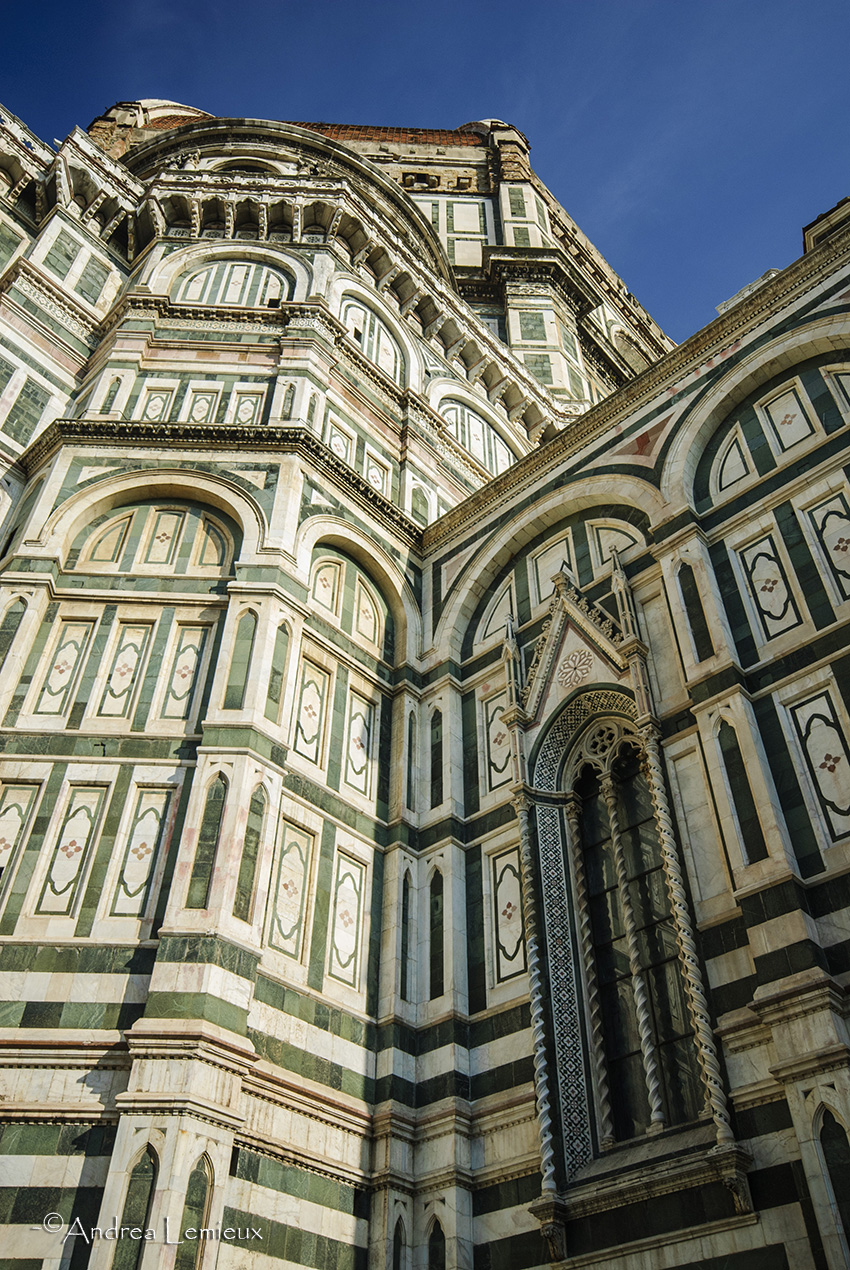
The Duomo of Florence

The best place to start a tour of Florence is the Duomo. For one thing, it sits pretty much in the center of things and so it makes a great point of reference. While I've never found the interior to be very impressive, the exterior is undeniably stunning.


'Duomo' is the Italian word for cathedral. The actual name of the Duomo is Santa Maria del Fiore (St. Mary of the flowers) and was built between 1294 and 1436. The exterior is paneled in green, pink, and white marble. It wasn't until 1887 that the facade we see, dedicated to the Mother of Christ, was done. I this the only other building I've photographed as much was St. Vitus in Prague. Some might say that the exterior of the Duomo is extravagant and over done but I have to go with 'spectacular'.


We were in Florence over a weekend which meant I needed to go to Mass. And if you have to go to Mass in Florence you might as well go to the Duomo! Especially when you're like me and think all Masses should still be in Latin and you know that the Duomo has a Latin Mass at 10:30 on Sundays. It was so nice to hear that again. I can count on one hand the number of things I miss about DC but Latin Mass at St. Matthew's is one of them. In Istanbul I semi confidently follow Mass in Italian and, weirdly, stumble through Mass when it's in English. I haven't regularly, or purposefully, attended English language Mass in 12 years. Also I take linguistic exception to some of the new translations.


As with St. Peter's you can buy a ticket to visit the dome, which L and I didn't do. Stairs. A shame as I'm sure the view of the city would be amazing. Frankly though every time we passed the Duomo I was stunned all over by the exterior and couldn't even contemplate the view.


I feel like even if I hadn't seen anything else while in Florence the time I got to spend admiring this amazing building would still have made it worth the trip. L said that it "kicks the ass of Milan's Duomo". I've never been to Milan so I'll have to take her word on that; but it really rather does kick the ass out of the majority of churches I've seen I rather suspect she's right.

05 February 2016

The Dead of Pompeii

One of the interesting things that I learned during our guided tour of Pompeii was that of the people who died (many did manage to escape) the majority were the wealthy of the city. They refused to leave because they were afraid that their houses would be raided and treasures stolen in the chaos/aftermath of the eruption.

Amphitheater at Pompeii


Temporary memorial exhibition

As I mentioned in my previous post about Pompeii, L and I gave into morbid curiosity when we heard there was a special exhibition in the amphitheater about the dead of Pompeii and how their final moments were recovered. Who doesn't want to see plaster casts of dead people?


The temporary exhibition is housed in a wooden pyramid and features not only plaster casts but a history about how these were done. I'll admit that until more recently than I'd like I assumed these plaster casts were the ashy remnants of the dead. Which is stupid because absolutely everything organic in Pompeii was consumed by the 250 C/482 F surges of heat from the ash.


You can see some of the bones and teeth still.


It was Giuseppe Fiorelli who, in 1863 realized that the cavities in the ash containing human remains were left by decomposed bodies. He devised a technique by which liquid plaster was injected into the cavities to recreate the body. His technique is still used today although with more durable resin instead of plaster.


The result of Fiorelli's discovery and the memorial exhibition is haunting. Yes there were certainly elements of the morbidity which drew L and me, especially when we caught the gleam of bones and teeth amidst the plaster; but it was far more moving than I expected.

29 January 2016

Legendary Pompeii

L and I both wanted to see Pompeii so we set aside a day during our Rome leg specifically for that. I spent a fair amount of time investigating how to get there and in the end we decided to book ourselves a shuttle "tour" with Enjoy Rome. This agency offers many tours and what we ended up booking was basically just a bus ride to/from Pompeii. I don't remember the price off the top of my head but I do remember that it was comparable in price but easier than booking a 35 Euro train ticket each way to Naples where we would transfer to a local train to take us to Pompeii.

The larger of the two theaters in Pompeii
A thermopolium

The size of Pompeii alone is impressive. Although over the last couple hundred years there certainly has been time to do major excavations. After its burial in ash in 79AM Pompeii was first rediscovered in 1599 but recovered only to be 'properly' rediscovered during the excavation of nearby Herculaneum in 1748 and has been a tourist destination for over 250 years. Not to sound like a ruins elitist or anything...but I've seen cooler. As a snapshot of ancient Roman life, art, and architecture it's phenomenal, don't get me wrong and the surviving frescos and artwork are beyond words. However Pompeii had nothing outstanding to single it out; no Roman Colosseum, no Ephesian Celus Library, or Athenian temples. Had it not been preserved by tons of volcanic ash Pompeii would have lived and died and been forgotten by history.

Traditional villa courtyard


Enjoy Rome offers two options with the shuttle deal: just the shuttle, or the shuttle and a two-hour guided tour. L and I chose to take the guided tour. While we didn't see as much of Pompeii as we could have done on our own we got a lot of information we wouldn't have got just from the guide book. Some of what he told I us I learned (but if I'm honest I learned then forgot) from the Roman architecture class I took. Some of it was very new.

Stepping stones for when streets flooded

Wall detail

For example, the old Latin word for brothels is lupanare. The root word for lupanare is lupus, wolf. I'd heard before that brothels were called lupanare and always wondered why. Our guide explained that in order to advertise their presence and guide customers through the streets to find them, the girls would lean out the windows and howl. If you needed more help than that to find the lupanare you could follow the penises etched/embedded into the streets that pointed the way. Seriously. Some of the surviving Pompeii frescoes are in the lupanare. According to our guide, the different paintings advertised a girl's particular skill or "game" and the stone beds in each room encouraged customers to play through quickly and not linger.

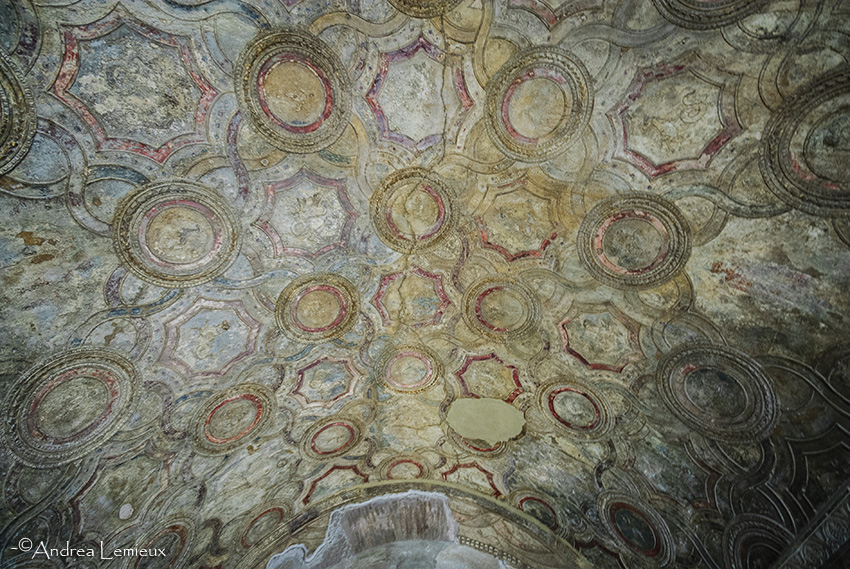
Ceiling detail
Public bath
A lupanara

Brothels weren't the only place to get your party on. You could also find 'company' on the floor above a thermopolium. Aside from the wealthy who had other people to do it for them and space for a dedicated kitchen, cooking was not a high priority. Many people got food from thermopolii where you could also enjoy a brief, unlicensed "game" upstairs. A thermopolium was like an ancient fast food place with large jars sunk into a counter where cold/dried foods and wine were stored and served to go.

'specialty' fresco in a lupanara
stone bed in a lupanara-does not encourage lingering!
'specialty' fresco in lupanara

After our tour we did not have much time left to wander around on our own. Choosing morbid curiosity over vivid frescoes we headed to the amphitheater where there was a special exhibition about the dead of Pompeii (will post about that soon!). As that didn't take quite as much time we suspected we elected to book it all the way across the city to visit the Villa of Mysteries.


On the outskirts of Pompeii, the Villa of Mysteries, despite also being buried in ash, sustained very little damage and many of its frescoes were found to be well-preserved after the villa was recovered. The villa gets its name from the frescoes in the triclinium (basically a dining room) which people believe depict a young girl being initiated into one of the more secret cults of Bacchus. If I were going to join a secret cult it would definitely be one headed up by the god of wine. Bravo young girl.

The triclinium